


Temple Run
Imangi Studios
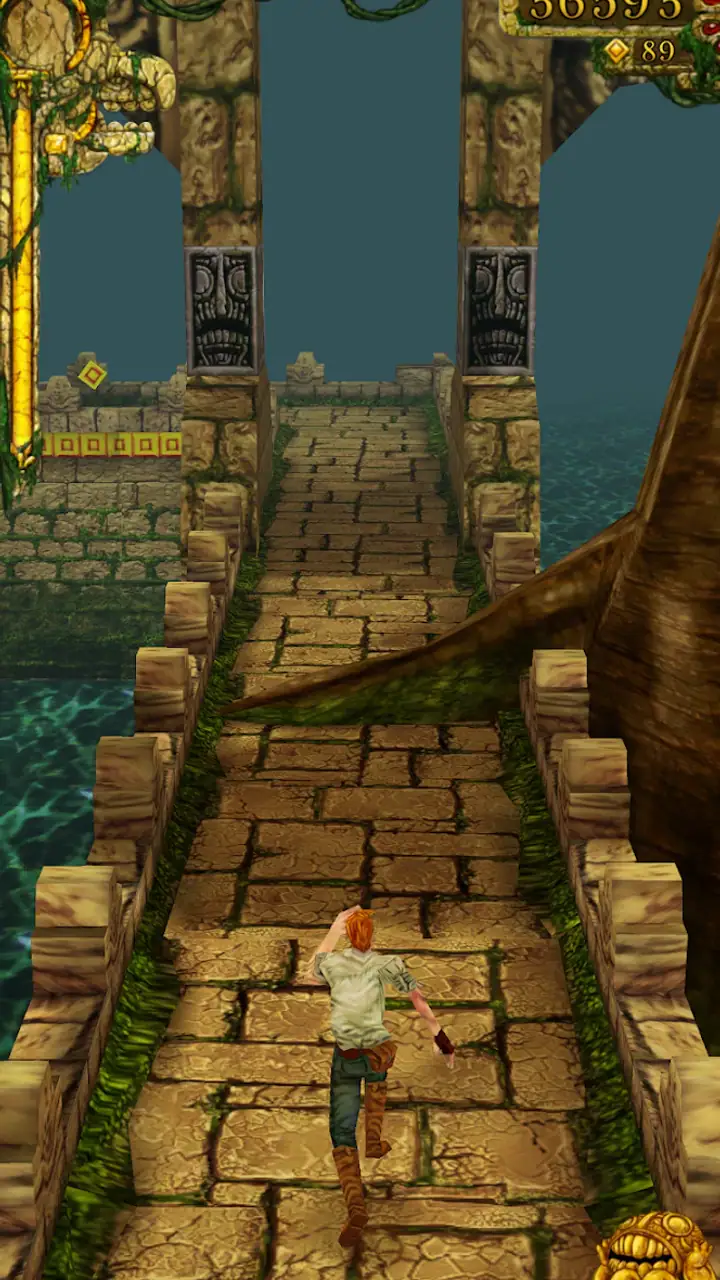
Temple Run is the kind of arcade game I can understand within seconds and still return to months later when I want a quick distraction. I guide a character along a dangerous temple route, react to turns and obstacles, collect what appears on the path, and try to keep a run alive longer than the previous one. That simplicity is the central appeal: there is no long tutorial, no complicated menu to study, and no story homework before the game becomes enjoyable.
After spending time with it, I see why Imangi Studios’ game became such a familiar name on mobile. It is free to start, rated for Everyone, and sits comfortably in the arcade category because each attempt is built around reflexes, timing, and a score-chasing loop. My honest view is that it earns a place on a phone when I want short sessions rather than a large game to live inside. The more difficult question is whether it remains interesting after the first burst of novelty. For me, the answer is yes, but only if I treat it as a compact habit instead of expecting constant discovery.
Why the first week feels so satisfying
The opening sessions are especially effective because the controls are easy to read. Swiping changes direction, helps avoid hazards, and makes the character respond immediately. Tilting the device adds another layer of movement, while taps and swipes work together when a jump or slide is needed. I never feel buried under buttons. The challenge comes from recognizing what is ahead and making the correct movement before the path disappears beneath me.
Related News

Granny: The Chilling Game Gripping Mobile Gamers

Temple Run: Why This Endless Runner Still Captivates
That design creates a useful rhythm. A run begins calmly enough for me to settle in, then the pace and visual pressure encourage faster decisions. A mistake usually feels understandable: I turned too late, jumped without enough space, or focused on a collectible instead of the obstacle beyond it. That clarity matters in an arcade game. When failure feels connected to my own decision, restarting is much easier than it would be in a game where random punishment seems to decide everything.
The first week also benefits from the game’s strong “one more attempt” quality. I can play while waiting for a coffee, during a short commute, or between larger tasks without needing to remember a complicated objective. A run has a natural beginning and ending, so I do not have to abandon a long campaign halfway through. When I have a few spare minutes, that makes it more practical than a traditional adventure game or a multiplayer title that expects a longer uninterrupted session.
Related News

Why WhatsApp Messenger Still Makes Everyday Communication Feel Easy

Jurassic World: The Game Is the Better Dino Tycoon for Strategic Players

Threads in Real Life: Who Should Join, Lurk, or Leave

How SHEIN Turned Shopping Into an Endless Content Feed

How to Make Fortnite Feel Smarter on Mobile

Should You Switch to Microsoft Outlook on Mobile?
My best early advice is to stop treating every visible collectible as mandatory. The path often presents a tempting line of rewards near a hazard, and chasing them can make a run end sooner than necessary. During my first sessions, I improved more by prioritizing survival and learning the route’s visual signals than by grabbing everything. Once the basic reactions became familiar, I could take more ambitious lines without turning every attempt into a desperate scramble.
Another useful habit is to keep my eyes slightly ahead of the character rather than staring directly at its feet. The game is easier to read when I scan for the next bend, gap, or obstacle while using the character’s position as a reference. This sounds minor, but it changes the experience from constant panic to anticipation. It is also the kind of small adjustment that gives the game more depth than its short store summary suggests.
The presentation supports that immediate appeal without asking me to decode a complicated world. The temple setting gives the run a clear identity, and the chase creates pressure even though the basic action remains straightforward. I do not need to know a lengthy backstory to understand the goal. For a casual player, that is a strength; for someone looking for character development, exploration, or a carefully paced narrative, it may feel thin almost immediately.
Gallery
Who gets the most from the opening sessions
I would recommend the first-week experience to people who enjoy improving through repetition. It suits players who like reaction games, personal bests, and short challenges that can be restarted instantly. It is also a good introduction to mobile arcade design for someone who does not usually play games on a phone, because the controls communicate their purpose quickly and the objective never becomes obscure.
It is less suitable for a child or adult who wants a calm, low-pressure activity. The chase and increasing speed keep the game tense, and repeated failure can become irritating rather than relaxing. It also will not satisfy someone who needs a rich progression system, dialogue, or a large world to explore. Temple Run is intentionally narrow. Its success depends on whether that narrow focus feels refreshing or repetitive to the person holding the phone.
What remains after the novelty fades
Month-to-month value comes from mastery rather than a steady stream of new ideas. I return because I know the game well enough to recognize my weak points, yet not well enough to remove all danger. A familiar route can still demand concentration when the pace rises. That makes each attempt feel like practice for the next one, especially when I am trying to improve consistency rather than simply survive by luck.
The game’s broad audience is reflected in its scale: it has passed 500 million installs and holds a 4.2 average from roughly 5.2 million ratings. Those figures do not guarantee that every player will enjoy it, but they match my impression that the design is immediately understandable across a wide range of experience levels. I can hand it to someone who rarely plays mobile games and expect them to begin experimenting without a long explanation.
For recurring value, I find it helpful to give each session a small purpose. One day I might focus on surviving longer; another time I might practice cleaner turns or attempt to collect more rewards without taking reckless routes. This prevents the game from becoming a mindless loop. It also reveals an important trade-off: the app does not always provide a fresh objective for me, so I have to create some of that structure myself.
That self-directed approach works well for competitive personalities. I can compare my own results across sessions and notice whether a change in technique actually helps. It works less well for players who expect the game to keep handing them substantial new content. If I need a campaign with chapters, a changing cast, or a deep construction system, another arcade or action game will probably offer more long-term variety.
Temple Run is also useful as a short reset between demanding activities. I have found that a brief attempt can break up a repetitive afternoon without consuming the rest of the day. The danger is that “brief” can quietly become repeated restarts, especially after a near-success. That is not a technical problem, but it is part of the game’s design pressure. Anyone trying to limit screen time should decide in advance how many runs count as a session.
The free entry point helps with that experimentation. I can install it and decide quickly whether the basic loop suits me without committing to a purchase. Optional items range from $0.99 to $19.99 each, so I would approach the in-app purchase system carefully rather than assuming every extra is necessary. My own recommendation is to play the core game first and treat spending as optional convenience, not as a requirement for discovering whether the running itself is enjoyable.
Small choices that improve repeated play
I get better results when I separate “safe” runs from “greedy” runs. In a safe run, I choose the clearest path and accept that I may leave rewards behind. In a greedy run, I deliberately test a riskier line and accept that the attempt may end quickly. Mixing both approaches without deciding which one I am practicing often produces frustration, because I am neither building consistency nor intentionally testing my limits.
I also avoid playing when my attention is divided. The game looks simple enough to operate while watching something else, but the important decisions arrive quickly and visual distractions make failure feel arbitrary. A focused short session is more satisfying than a longer session played half-heartedly. This is one reason it works better for me as a deliberate break than as background entertainment.
Finally, I use the early portion of a run as a warm-up rather than immediately chasing a record. The first attempts after a break are often less precise, and forcing an ambitious score before my timing returns makes the game seem harsher than it is. Treating those runs as practice gives the month-to-month loop a more sustainable shape.
The maintenance burden is refreshingly low, but not invisible
One reason the game can keep a place on my phone is that it demands little preparation. I do not need to organize a team, remember a complicated quest, or reserve a large block of time. I can open it, play, and leave. The current version is 1.35.0 and requires Android 6.0 or later, which makes the basic access requirement relatively approachable for compatible Android devices. On iOS, the same central appeal remains: quick entry and quick exit.
That low maintenance does not mean zero friction. The game still asks for attention, and repeated attempts can make a short break feel more intense than intended. I also have to manage my expectations around free-to-play extras. Because optional purchases are present, I would not hand the phone to a child without first deciding how purchases should be handled. The Everyone rating describes the content broadly, but it does not remove the need for sensible device supervision.
There is no large personal routine to maintain, which is a major advantage over games that depend on daily tasks or lengthy progression checklists. I can ignore it for weeks and return without feeling lost. That makes it a strong backup game: it does not punish me for taking a break by demanding that I catch up on missed systems. For players who dislike obligations disguised as entertainment, this simplicity is one of its most durable qualities.
On the other hand, the same lack of obligation can weaken the habit. If I stop setting personal goals, the game can become something I open automatically, play without focus, and close without feeling that the session meant anything. Its maintenance burden is low because the game leaves much of the motivation to me. That is convenient, but it also means the long-term relationship depends heavily on whether I enjoy self-improvement.
Where fatigue begins
The main source of fatigue is repetition. The controls are elegant, but they do not change their fundamental purpose. I am still reading the route, reacting to danger, and trying to extend the run. At first, that loop feels clean and addictive. Later, the same clarity can feel restrictive, particularly when I am no longer learning new techniques and am simply repeating familiar reactions.
Near-misses can also become tiring. A failed run after a strong attempt creates motivation to try again, but several failures in a row can turn that motivation into irritation. I sometimes find myself playing more aggressively after a mistake, which usually produces another mistake. The practical solution is to stop after a poor sequence instead of assuming the next run must repair the previous one.
The reward path presents another trade-off. Collectibles give me a reason to move toward particular parts of the route, but they can distract from the safer option. Players who naturally chase every visible reward may find the game more stressful than players who value distance first. That tension is interesting for a while, yet it can become predictable once I understand that the most attractive line is not always the best line.
There is also a ceiling to the kind of challenge the game offers. It tests reaction speed, visual scanning, and consistency, but it does not provide the strategic variety of a puzzle game or the social unpredictability of a competitive multiplayer game. If my taste changes toward planning, storytelling, or cooperation, Temple Run will not adapt with me. I would then choose a different game rather than forcing this one to become something it was never designed to be.
Players sensitive to motion or rapid visual movement should approach it cautiously and take breaks if the presentation feels uncomfortable. Even without a technical issue, the constant forward motion can be demanding during long sessions. I find that the game is at its best in short bursts, which conveniently matches its structure and reduces the chance that the visual intensity becomes exhausting.
My long-term verdict
After the first-week excitement has settled, I still think Temple Run deserves space on a phone, but with a specific expectation: it is a dependable reflex-based pastime, not an endlessly expanding destination. Imangi Studios made the central action accessible enough for newcomers while leaving room for players to improve their timing and route choices. That balance explains why the game remains recognizable and useful as a quick arcade option.
I would choose it over a more demanding alternative when I want immediate play, personal score chasing, and no obligation to remember a larger game world. I would choose something else when I want narrative progress, strategic decisions, social play, or a calmer pace. That distinction is important because the game’s limitations are not hidden flaws; they are the boundaries of its focused design.
The free price makes trying it easy, while the optional purchases mean I would keep an eye on spending rather than assuming the entire experience is purchase-free. Its Everyone rating makes it broadly approachable, and the large player base suggests that its basic controls have proven easy to understand. Still, popularity cannot replace personal fit. Someone who dislikes repetition will probably reach the fatigue stage quickly, no matter how polished the first sessions feel.
My final recommendation is simple: install it if you want a compact arcade game that rewards attention in short, repeatable sessions. Give yourself a goal, favor survival before greed, and stop when your reactions become careless. If you do that, the game can remain a useful little habit long after the initial novelty fades. Its lasting value comes from reliable replayability, not constant surprise.
FAQs for Temple Run
What are the main objectives of Temple Run?
In Temple Run, the primary goal is to navigate your character through an endless maze of obstacles while collecting coins and power-ups. The game emphasizes quick reflexes and strategic decision-making as you swipe and tilt your device to avoid pitfalls, jump over barriers, and escape the pursuing demon monkeys.
Is Temple Run free to play, and does it include in-app purchases?
Temple Run is free to download and play on both Android and iOS platforms. However, it does offer in-app purchases that can enhance gameplay, such as coin packs and character upgrades. While these purchases are optional, they can help players advance more quickly and customize their gaming experience.
What devices are compatible with Temple Run?
Temple Run is compatible with most modern Android and iOS devices. It requires iOS 9.0 or later for Apple devices and Android 4.1 or higher for Android phones and tablets. The game is optimized to run smoothly on a wide range of devices, ensuring accessibility for many users.
How can I improve my performance in Temple Run?
Improving performance in Temple Run involves mastering the swipe and tilt controls, learning the obstacle patterns, and utilizing power-ups effectively. Regular practice helps enhance reflexes and anticipation. Additionally, upgrading abilities and characters with collected coins can provide advantages in avoiding obstacles and increasing scores.
Is an internet connection required to play Temple Run?
Temple Run does not require an internet connection for basic gameplay, allowing you to enjoy it offline. However, an internet connection may be necessary for certain features, such as viewing leaderboards, making in-app purchases, and receiving updates. Playing online also allows you to sync your progress across devices.
Pros
- Engaging endless runner gameplay.
- Simple controls for easy play.
- Visually appealing graphics.
- Regular updates with new features.
- Free to download and play.
Cons
- Repetitive gameplay may get boring.
- In-app purchases can be costly.
- Occasional ads interrupt play.
- Requires internet for some features.
- Device battery drains quickly.


